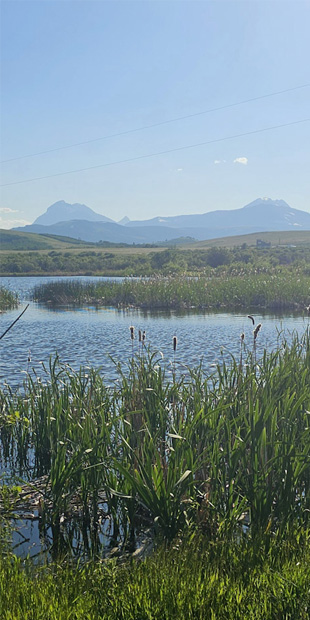
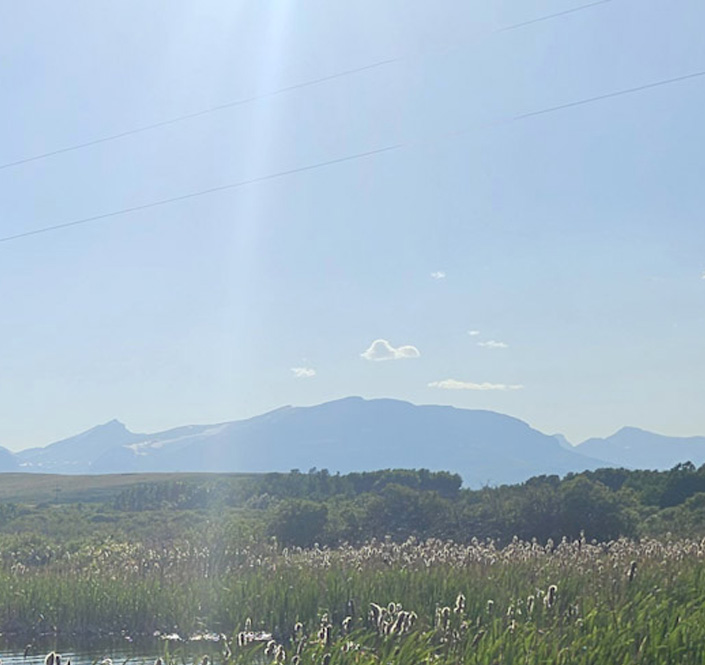
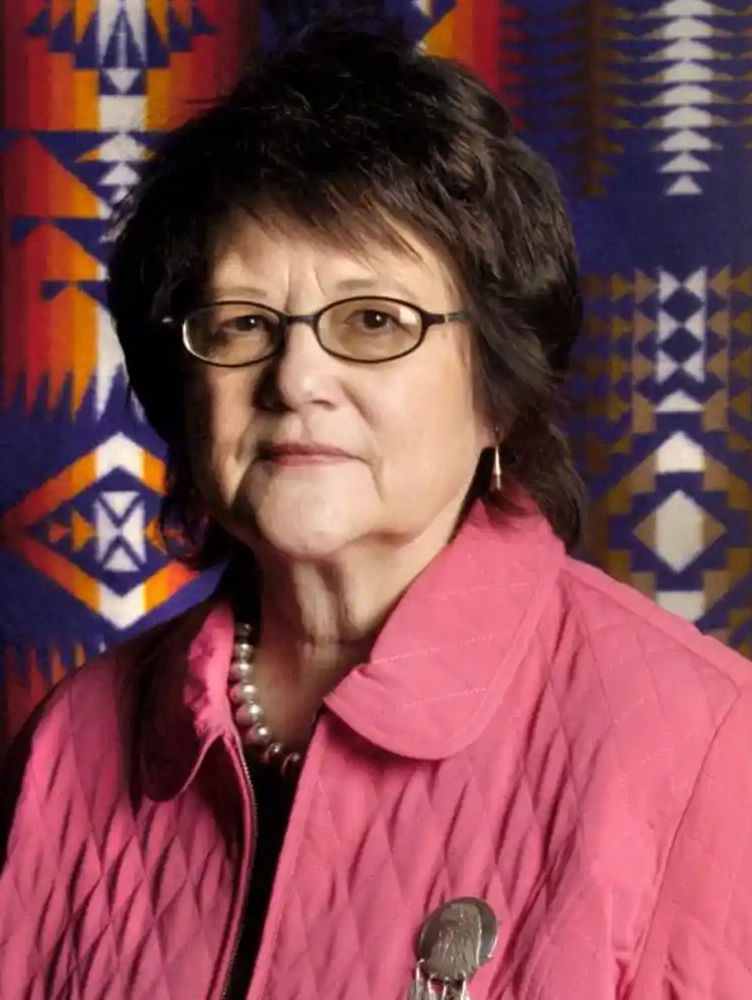
The Yellow Bird Woman Sanctuary was founded for the mutual well-being of amskapi piikani land and people. Elouise Cobell (ōt”kwaipiiᐧksaakii) envisioned bringing the land and the people together, hoping the Sanctuary would be protected by and for them in celebration of natural wonder and abundance. BILT works to manage this land as a model of tribal-led conservation and stewardship.
Wetlands and Glacial Fen
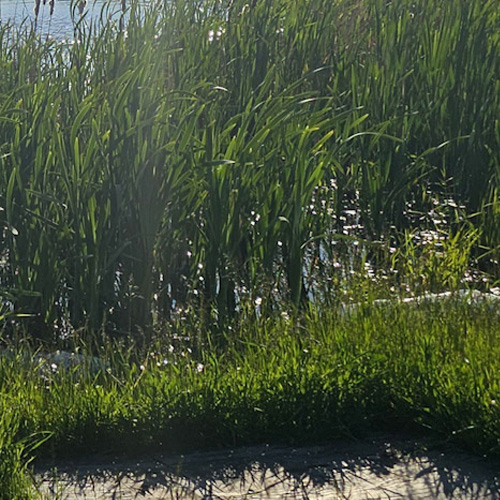
The amskapi piikani homelands hold some of the most pristine water in the United States. The Yellow Bird Woman Sanctuary was prioritized for protection in part because of a precious natural water system known as a glacial fen. A glacial fen is a groundwater-fed wetland in which mineral-rich water is constantly drawn up from deep in the earth, feeding plants and animals at the surface. Unlike a marsh or a bog, which depend on rainfall, a fen is fed by groundwater that has slowly filtered through rock and soil, picking up nutrients along the way. This steady, mineral-rich water supply makes fens some of the most biologically diverse wetlands in the world.
Fens like the one at Yellow Bird Woman Sanctuary are ancient ecosystems. They form over thousands of years as wetland plants grow, die, and accumulate into a thick layer of peat – organic material that builds up slowly because the cold, saturated conditions of a fen slow decomposition. Peat accumulates at a rate of just 8 to 11 inches per thousand years, meaning the peat layer beneath a fen may hold a record of plant life and climate stretching back 10,000 years or more, all the way to the retreat of the glaciers. Along the Rocky Mountain Front, fens like this one form where groundwater rises to the surface at the base of slopes, creating pockets of lush, productive wetland within an otherwise semi-arid landscape.
In addition to supporting wildlife and rare plant species, fens act as both natural water filters and sponges. They remove excess nutrients, improving the quality of water that flows downstream, and arbsorb heavy rainfall and snowmelt for slower release, which helps prevent flooding and keeps streams flowing steadily through dry seasons. The fen at the Yellow Bird Woman Sanctuary is part of the broader water system of the Blackfeet Reservation, and its health is connected to the health of the streams, wetlands, and communities that depend on clean water across the landscape.
The Yellow Bird Woman Sanctuary fen is classified as “extremely rich fen” – found in only a handful of locations across the Northern Great Plains. A 2013 study of the fen documented five distinct wetland plant communities, including 93 species of vascular plants and a diversity of microscopic algae called diatoms- including a “new to science” species. This level of biodiversity is remarkable for a semi-arid, mountainous landscape. Changes to the groundwater that feeds the fen, whether from development, drought, or a shifting climate, could permanently alter or destroy communities that took millennia to develop.
Sources:
Montana Field Guide – Rocky Mountain Subalpine-Montane Fen / Rocky Mountain Alkaline Fen (Montana Natural Heritage Program): https://fieldguide.mt.gov/displayES_Detail.aspx?ES=9234
Luna, Tara, Peter Lesica and Dave Hanna. 2013. “IPA-Connelly Fen.” Montana Native Plant Society http://www.mtnativeplants.org/fileaccess/getfile/415.pdf
BioOne – “An Extremely Rich Fen on the Plains of the Blackfeet Indian Reservation, Montana” (Natural Areas Journal, 2017): https://bioone.org/journals/natural-areas-journal/volume-37/issue-4/043.037.0403
Native Grasslands and Prairie Potholes
The majority of land protected in the Yellow Bird Woman Sanctuary is dominated by deep-rooted native grasses that define the Rocky Mountain Front, and managing this land centers on piikani knowledge. These grasslands have been shaped over thousands of years by the relationship between land, water, people and grazing animals. Vast herds of iinii (bison) once moved across this landscape in numbers that are difficult to imagine today, with the amskapi piikani traditional seasonal round both following and directing these movements. Iinii grazing, wallowing, and seasonal migrations maintained the structure and diversity of the prairie ecosystem.
When iinii were nearly eliminated from the plains in the 19th century, cattle ranching became the primary land use on the reservation. Today the Blackfeet Nation is an active ranching community supporting over 65,000 cattle. At the Yellow Bird Woman Sanctuary, BILT works with Blackfeet ranchers and partners to implement wildlife-friendly grazing practices that support rather than degrade plant communities.
Prairie potholes, also known as kettle ponds, are an essential part of grazing systems and wildlife habitat at Yellow Bird Woman. These shallow, glacier-carved depressions fill with snowmelt and spring rains, providing critical water for livestock and reducing overuse of any single area. The prairie potholes of the Yellow Bird Woman Sanctuary are part of the broader Prairie Pothole Region – a vast landscape of glacially formed wetlands stretching from Montana to Iowa and across southern Canada. The Prarie Pothole Region is known as the continent’s “duck factory” and considered the most important waterfowl breeding and migration habitat in North America, producing an estimated 50 to 80 percent of North America’s breeding waterfowl.
Scattered across the grasslands and around kettle ponds are groves of quaking aspen, or “Napi’s eyes.” These groves provide medicine and are especially important for wildlife in the transition zones between grassland and forest.
One of the most significant ongoing land management challenges at Yellow Bird Woman and across the Blackfeet Reservation is the control of invasive weeds, especially spotted Knapweed. Knapweed is an aggressive non-native plant that spreads rapidly in disturbed soils and outcompetes native grasses by releasing chemicals that inhibit the growth of neighboring plants. Knapweed reduces forage quality, decreases biodiversity, and can take over entire hillsides if left unmanaged. Controlling it requires sustained effort – a combination of biological controls, targeted herbicide application, and ongoing land monitoring, which is central to BILT’s stewardship approach. On the Blackfeet Reservation more broadly, knapweed management is a shared priority across tribal ranchers, the Blackfeet Nation and conservation organizations.
Sources:
USDA NRCS – Stewardship and Resilience on the Blackfeet Nation https://www.nrcs.usda.gov/state-offices/montana/news/stewardship-and-resilience-preserving-the
Montana Field Guide – Great Plains Prairie Pothole https://fieldguide.mt.gov/displayES_Detail.aspx?elcode=CES303.661
Prairie Pothole Joint Venture https://ppjv.org/prairie-pothole-region/
Montana Field Guide – Rocky Mountain Lower Montane Grassland https://fieldguide.mt.gov/displayES_Detail.aspx?ES=7112
Subalpine Forest
The southern corner of the Yellow Bird Woman Sanctuary includes a landscape transition into higher elevations that extend to the steep slopes and ridgelines of Glacier National Park. The slow-growing, resilient trees and cushion-forming shrubs and forbs of this subalpine plant community exist in an environment shaped by extremes.
Limber pine, named for its flexible branches that are adapted to a high-wind environment, is a close relative of the whitebark pine and shares many of its ecological functions. It grows on the most exposed, windswept ridges and rocky slopes where few other trees can survive, often marking the upper edge of forest at treeline. Some limber pines live for more than 1,000 years. The large, nutritious seeds are an important food source for Clark’s nutcrackers, red squirrels, and grizzly bears, and the trees themselves provide nesting habitat for songbirds and small mammals. Like whitebark pine, limber pine is under increasing pressure from the introduced threat of the white pine blister rust fungus, as well as mountain pine beetle and the shifting conditions brought by climate change.
The subalpine fir, known as k̇ǎṫo´yiss (sweet pine), is one of the most culturally significant trees for amskapi piikani. Its needles carry a distinct, sweet fragrance and are commonly used as smudge or spiritual medicine, can also be a natural deodorant and preservative. The needles, bark and resin of k̇ǎṫo´yiss’s have been used to treat respiratory ailments, reduce fever, and disinfect wounds.
In these harsh, high-elevation environments, limber pine and subalpine fir play a critical role in stabilizing soil against erosion, capturing snowdrift, and regulating the slow, steady release of meltwater into the streams and wetlands below (such as Yellow Bird Woman’s glacial fen and prairie potholes). In addition to food, they provide critical habitat and thermal protection for elk, deer, and other ungulates through winter.
Sources:
Montana Field Guide – Rocky Mountain Foothill Limber Pine-Juniper Woodland and Montane-Subalpine Limber Pine Woodland: https://fieldguide.mt.gov/displayES_Detail.aspx?ES=4236 and https://fieldguide.mt.gov/displayEG_Detail.aspx?EG=EVFM0G101
USDA Forest Service Silvics – Limber Pine: https://research.fs.usda.gov/silvics/limber-pine
Galileo / Kainai Nation – Sweet Pine/Alpine Fir https://galileo.org/kainai/alpine-fir/
University of Montana Native Garden https://www.umt.edu/native-garden/circles/blackfeet.php
Wildlife
The Yellow Bird Woman Sanctuary is at the transition zone between the Rocky Mountain Front and the Northern Great Plains. Here, within just a few miles, the landscape shifts from subalpine ridgelines and dense forest to open fescue grassland, wetland, and prairie. This dramatic gradient in elevation and, subsequently, climate and vegetation type, creates a habitat mosaic that supports an extraordinary diversity and abundance of wildlife. The traditional amskapi piikani Seasonal Round moves across this mosaic along with the wildlife, with humans and non-human relatives following longstanding patterns of seasonal abundance. Today, the Rocky Mountain Front remains one of the most important wildlife corridors in North America.
All aspects of Yellow Bird Woman- wetlands, grasslands, prairie potholes, aspen groves, and forest edges– function as an integrated system. These non-human relatives are our teachers and BILT works to balance community use and grazing of the property with the travel paths and needs of these species. Because the Yellow Bird Woman Sanctuary is a protected property (no hunting is permitted on the land) it functions as a year-round refuge for wildlife to move, rest, forage, and raise young. The following are some of the most notable visitors and residents:
Grizzly Bear
Grizzlies are one of the most powerful presences on the Rocky Mountain Front and connected to strength and medicine for amskapi piikani. Ecologically, grizzlies are wide-ranging omnivores whose diet shifts dramatically through the seasons – from roots and ground squirrels in spring to berries, moths, and whitebark or limber pine seeds in late summer and fall. The Rocky Mountain Front is part of the Northern Continental Divide Ecosystem, which supports one of the largest grizzly populations in the contiguous United States. Grizzlies along the Front have expanded their range in recent decades, with females now documented denning on open prairie many miles east of the mountains. The Yellow Bird Woman Sanctuary provides important foraging and movement habitat for bears traveling between mountain and prairie.
Swift Fox
The swift fox is the smallest member of the dog family in North America – weighing just five pounds, not much larger than a housecat. Killing a swift fox was traditionally forbidden for amskapi piikani, but by the mid-20th century swift foxes had been eliminated from Montana, largely due to the widespread use of poisons intended for wolves and coyotes. Beginning in 1998, the Blackfeet Tribe partnered with Defenders of Wildlife and the Cochrane Ecological Institute of Canada for the first swift fox reintroduction in North America. By 2006, the reintroduction was declared a success, with a growing population establishing itself across the reservation’s grasslands and spreading beyond the reservation boundary to the Rocky Mountain Front.
Moose
Moose are the largest members of the deer family and a dominant presence in the wetland and riparian areas of the Yellow Bird Woman Sanctuary. Despite their massive size (bulls can weigh over 1,000 pounds!) moose are surprisingly graceful in water, wading and swimming readily to feed on aquatic vegetation. They are solitary animals for most of the year, with cows requiring dense riparian cover to raise their calves through the summer.
Waterfowl
In Spring and Fall, Yellow Bird Woman Sanctuary comes alive with the sound and movement of birds moving through the Central and Pacific flyways on their way to and from Arctic and subarctic breeding grounds. Tundra swans, Canada geese and snow geese pass through in flocks that can number in the hundreds, stoping to rest and feed on the grasslands and potholes. The rattling, prehistoric cries of sandhill cranes are heard from the wetlands, where they pass through in pairs or small groups. Dozens of duck species use the pothole complex for breeding and migration stopovers, reflecting Yellow Bird Woman Sanctuary’s place within the broader Prairie Pothole Region – one of the most critical waterfowl habitats in the Western Hemisphere.
Raptors
The open grasslands, wetlands, and thermals above the Rocky Mountain Front make the Yellow Bird Woman Sanctuary an exceptional habitat for birds of prey. Golden eagles nest along the rocky outcrops of the Front and hunt the open grasslands for ground squirrels, rabbits, and other small mammals. Bald eagles gather along watercourses and wetlands, particularly during fall and winter when migrating birds flock to the Front. Sharp-shinned hawks are forest-edge specialists, hunting songbirds through the aspen groves and woodland borders of the Sanctuary. Red-tailed hawks perch on fence posts and snags at the edge of grasslands and circle on updrafts over the open prairie, hunting rodents and rabbits.
Elk
Rocky Mountain elk are an important animal in piikani cultural and traditions, historically hunted alongside bison as a primary food source. Elk herds move through the Yellow Bird Woman Sanctuary seasonally, using the grasslands for summer grazing and moving to lower elevations and forested areas in winter. Because no hunting is permitted, the property functions as year-round refuge and a place where elk can graze, rest, and calve without disturbance.
Other Top Predators
The full suite of large predators of the Northern Rockies is present in and around Yellow Bird Woman Sanctuary, a reflection of the landscape’s ecological integrity. Mountain lions – solitary, secretive ambush hunters – are the most widely distributed large cat in the Americas and important regulators of deer and elk populations. Coyotes are highly adaptable and present year-round, hunting small mammals, birds, and insects. Black bears forage for berries, insects, and roots through the summer and fall. Bobcats hunt rabbits, grouse, and rodents along the forest and grassland edges. Gray wolves are a rare but increasing presence at Yellow Bird Woman Sanctuary following their recovery and expansion across the amskapi piikani landscape.
Sources:
Blackfeet Nation Fish and Wildlife – About Us (reservation wildlife list, hunting permits): https://blackfeetfishandwildlife.net/about-us/
Vital Ground / Northern Continental Divide Ecosystem https://www.vitalground.org/habitat-projects/right-places-northern-continental-divide-ecosystem/
Defenders of Wildlife https://defenders.org/blog/2015/09/little-fox-prairie
ScienceDirect – Swift Fox Reintroductions on the Blackfeet Indian Reservation https://www.sciencedirect.com/science/article/abs/pii/S000632070600574X
The Nature Conservancy – Pine Butte Preserve (Rocky Mountain Front wildlife including grizzly, moose, raptor diversity): https://www.nature.org/en-us/get-involved/how-to-help/places-we-protect/pine-butte-swamp-preserve/
University of Montana – Blackfeet Reservation: https://www.umt.edu/native-garden/circles/blackfeet.php